
Illustrated Standard
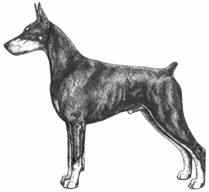
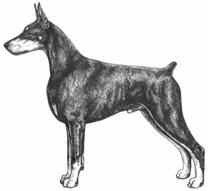
A number of years ago, the Doberman Pinscher of America developed an illustrated standard with graphic illustrations of what breeders expect the Doberman to look like when it is judged against the AKC standard. Advances in technology and publishing, along with the the availability of photographs of outstanding specimens, has caused the DPCA to consider a new issue of the illustrated standard.
The new Illustrated Standard (issued in 2006) appears on this web site in its entirety. It is a rather lengthy document. Printing the web pages will not provide you with an integrated Illustrated Standard, because you will print other information on the page, such as headers and footers. We considered making the Illustrated Standard available as an Acrobat Reader PDF file. However, converting to this file format lowers the quality of the drawings considerably.
If you are interested in a copy of your own Illustrated Standard, please visit our shop.
We have provided photographs of excellent representatives of our breed elsewhere on this web site. We think that these pictures will supplement the graphics that you find in this Illustrated Standard.
Please navigate through the Illustrated standard using the links shown below. We believe the links are self-explanatory and we hope that we have provided you with clear and easy access to all portions of the Illustrated Standard.
Intro General Appearance Size/Proportion Head Neck/Top/Body Forequarters Hindquarters Coat Gait Temperament
Introduction
This edition of the Doberman Pinscher Illustrated Standard is effective October 2006 and was prepared by the Illustrated Standard Committee of the Doberman Pinscher Club of America .
Its purpose is to be a resource for students of the breed whose experience varies from the long-time specialists to the novice. It will prove useful to judges, potential judges, breeders, exhibitors, owners, and others who have an interest in learning about the correct attributes of the Doberman Pinscher.
This revision to the Illustrated Standard contains all-new graphics and commentary. The new graphics represent proper conformation as well as typical deviations. The deviations are shown to provide information to aid the student in recognizing the ideal Doberman rather than leading the student to “fault judging.”
The DPCA extends its thanks to the committee members who contributed many long hours and the benefit of their knowledge for the preparation of this booklet.
ILLUSTRATED STANDARD COMMITTEE OF THE
DOBERMAN PINSCHER CLUB OF AMERICA :
Robert L. Vandiver – Chairman
Faye Strauss
Judy Doniere
Marj Brooks
Jeanne Flora – Artist
How to read this illustrated standard
AKC Standard
The information provided in the Illustrated Standard follows the sequence of the AKC standard. The section that is written with this font is quoted directly from the AKC standard.
Following each section of the standard is a discussion of that section of the standard using this format. The discussion supplements the written standard and provides additional information for the reader. The text in this format embodies discussion and is not a part of the AKC standard.
Graphics placed in each section illustrate the element of the standard that is under discussion. Some of these graphics represent the DPCA’s ideal Doberman Pinscher. Others represent deviations that are often seen in the breed.
General Appearance
AKC Standard
GENERAL APPEARANCE
The appearance is that of a dog of medium size, with a body that is square. Compactly built, muscular and powerful, for great endurance and speed. Elegant in appearance, of proud carriage, reflecting great nobility and temperament. Energetic, watchful, determined, alert, fearless, loyal and obedient.
Commentary
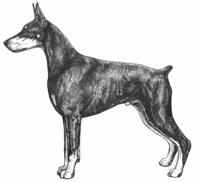
The standard stresses the Doberman’s unique combination of physical traits that reinforces the axiom “form follows function.” Our standard calls for a square dog of medium size, compact and muscular. He appears larger than he really is because of his heavy bone and substance. His square physique and smooth, hard musculature create the agility, speed, endurance and strength that characterize the Doberman in action and permit him to excel at his work. From the arch of his neck to the tip of his tail, the sleek, powerful Doberman should be the picture of athleticism.
The Doberman is elegant in appearance, which is to say the dog appears to be a seamless, balanced whole, as opposed to being delicate or refined. He has a superbly arched neck that flows smoothly into correctly angulated shoulders. His strong topline has no bumps or dips. The tail is readily seen as a continuation of the spine. The coat is short, smooth and tight, and there should be no looseness to the skin. The skin fits so tightly that the Doberman seems to be poured into it.
Another aspect of his elegance is his noble bearing, which emanates in large part from an acute awareness of his environment. The Doberman leaves no doubt that he owns the ground on which he stands. Firm, purposeful, strong willed and determined, the Doberman navigates around complex obstacles calmly and gracefully.
The standing dog’s structure must be confirmed when the dog is moving.
Temperament is paramount in our breed. Without good temperament you do not have a Doberman. Temperament is essential for breed type. (See the temperament section for an in-depth discussion of breed temperament.)
 Ideal Dog |
 Ideal Bitch |
Size/Proportion
AKC Standard
SIZE, PROPORTION, SUBSTANCE
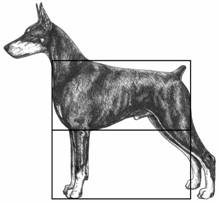
Height at the withers: Dogs 26 to 28 inches, ideal about 27½ inches; Bitches 24 to 26 inches, ideal about 25½ inches. The height measured vertically from the ground to the highest point of the withers, equaling the length measured horizontally from theforechest to the rear projection of the upper thigh. Length of head, neck and legs in proportion to length and depth of body.
|
|
Commentary
The standard requires Dobermans to be of medium size, which gives them more endurance and greater agility than many larger dogs. Heavy boned and athletic, Dobermans are able to generate the power to excel at their working functions.
In the standard, all measurements are proportional to the height of the dog at his withers. All parts should be in proportion to the body size.
The height of the dog is measured from the highest point of the withers to the ground. The length of the body is measured from the point of the forechest to the rear projection of the upper thigh (or shank).
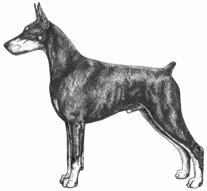
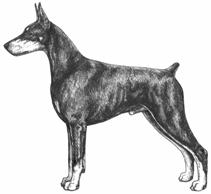
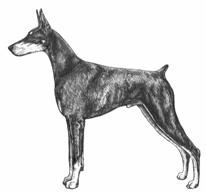
Correct Body Length
Long BodyThe leg measured from the elbow to the ground is equal to the depth of the body. The body of the Doberman with these measurements will be square.
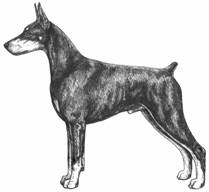
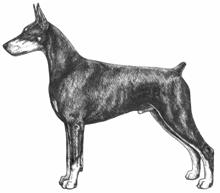
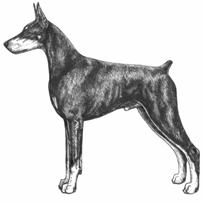
Long Legs
Ideal
Short Legs
There must be a balance of bone density, substance and body size in relation to the height. Dogs that measure over the standard lack that balance and should be penalized. Dogs that are more than 1 inch over maximum height are large-sized, rather than medium-sized as required by the standard, thus are not of correct breed type. You will not see many undersized specimens. Some males have ideal height but appear feminine because of a lack of bone and substance and should be penalized as well. The standard calls for heavy bone in the forelegs. Heavy bones in the forelegs imply heavy bones through the dog’s structure without tending toward coarseness. The heavy bone, Doberman temperament, and elegant appearance create a generally imposing presence.
Coarse
Ideal
Refined
The Doberman is square, substantial and balanced. His head is in balance with his neck and body. His front is in balance with his rear. If any part of a Doberman stands out or is not in harmony with the rest of the dog, it is a deviation.
Head
AKC Standard
HEAD
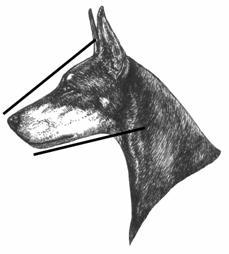
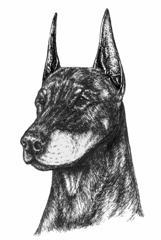
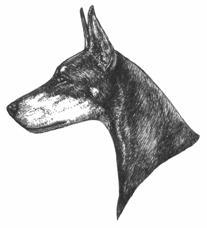
Long and dry, resembling a blunt wedge in both frontal and profile views. When seen from the front, the head widens gradually toward the base of the ears in a practically unbroken line. Eyes almond shaped, moderately deep set, with vigorous, energetic expression. Iris, of uniform color, ranging from medium to darkest brown in black dogs; in reds, blues, and fawns the color of the iris blends with that of the markings, the darkest shade being preferable in every case. Ears normally cropped and carried erect. The upper attachment of the ear, when held erect, is on a level with the top of the skull.
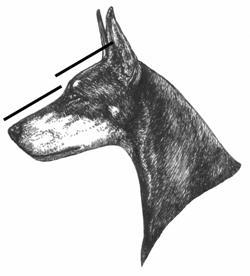
Top of skull flat, turning with slight stop to bridge of muzzle, with muzzle line extending parallel to top line of skull. Cheeks flat and muscular. Nose solid black on black dogs, dark brown on red ones, dark gray on blue ones, dark tan on fawns. Lips lying close to jaws. Jaws full and powerful, well filled under the eyes.
Commentary
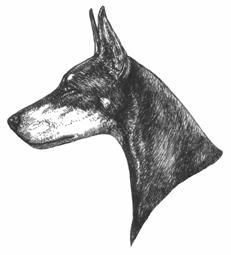
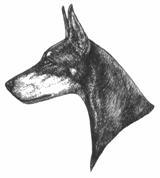
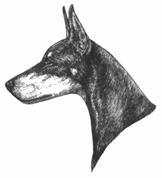
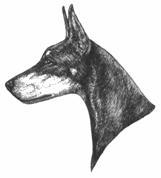
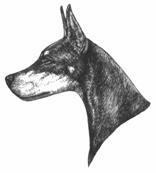
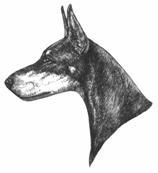
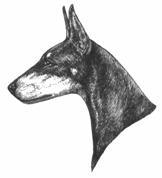
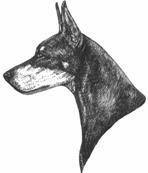
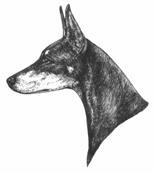
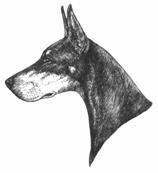
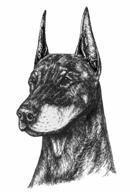
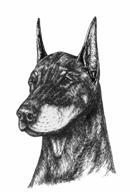
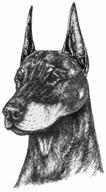
The Doberman’s head is essential to breed type. There are a few criteria that must be met for the head to conform to the standard. However, it is possible for all of these criteria to be met and still have correct heads that are appreciably different from one another in overall look.
The head must be long (but always in balance with the neck and body) and dry. The term “dry” means that there should be no looseness of skin. As with the body, Dobermans should have tight-fitting skin on the head, with few or no wrinkles when the dogs are fully alert.
The shape of the head is a blunt wedge that should be apparent when viewed from the front or from the side. The wedge can vary in width. Typically, a heavily-built dog will have more breadth to the head and therefore a wider wedge than a more slightly-built dog, which generally has a narrower wedge. What matters is that the width of the head be in proportion to the dog’s overall conformation.
When approaching the Doberman head on, two flat planes fitting flush with the sides of the head should be visible. The head widens from the nose to the ears in a nearly straight line.
Eyes are almond shaped and dark — the darker, the better. Common faults are light eyes, round eyes, and oblique eyes. Round eyes seem to be much more prevalent than oblique eyes. The Doberman is a protection dog and should have eyes that convey alertness, determination, watchfulness and unmistakable fearlessness. Round eyes can create a soft, gentle appearance that deviates from the Doberman’s ideal appearance. Similarly, light eyes and bird-of-prey eyes are deviations from the standard.
Ears are normally cropped and carried erect. “Normally cropped” means cropped in a normal manner. Normally cropped does not mean “usually cropped.” Cropped ears will always be carried erect on a fully mature Doberman. The upper attachment of the ear to the head should be level with the top of the backskull when the dog is alert. The shape of cropped ears can vary because veterinarians exert their own vision on the final shape.
From his inception, the Doberman has been cropped. It is an essential breed characteristic. Cropped ears impart an appearance of alertness, determination, and watchfulness, and they aid in multi-directional hearing. In our standard, we do not describe an uncropped ear because this is a cropped breed. Dobermans with uncropped ears deviate from the standard twice — first by not having cropped ears, as required by the standard, and second by not having an erect ear carriage.
The top of the skull is flat, as are the cheeks. These surfaces, along with the slight stop, create the impression of planes and angles. Curves can give a softer look to the head, which is contrary to the characteristic appearance of the Doberman.
The muzzle is parallel to the backskull. Although the standard does not address muzzle length, the length of the muzzle should be equal to the length of the backskull. The muzzle is strong and powerful with a fully developed underjaw, which should be clearly apparent when viewing the head in profile. The lips, including the flews, should be tight-fitting.
Ideal headTypical deviations
Prominent frontal arc h
Dish Faced
Roman Nose
Down face too little stop
Short Coarse Muzzle
Snipey Muzzle
Wet Lippy Muzzle
Ideal
Low ear set
Cheeky
AKC Standard
Teeth
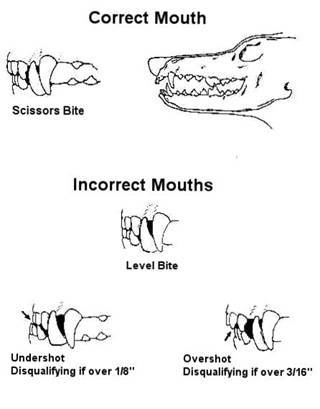
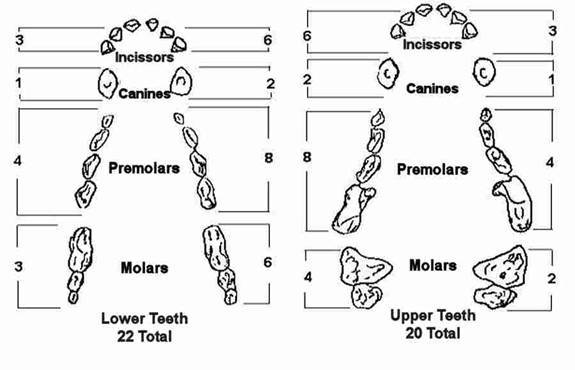
Teeth strongly developed and white. Lower incisors upright and touching inside of upper incisors a true scissors bite. 42 correctly placed teeth, 22 in the lower, 20 in the upper jaw. Distemper teeth shall not be penalized. Disqualifying Faults: Overshot more than 3/16 of an inch. Undershot more than 1/8 of an inch. Four or more missing teeth.
Teeth should come together in a scissors bite — that is, the outside top edge of the lower incisors should meet the inside edge of the upper incisors as shown. Lower incisors should be upright. Incorrect bites include a level bite (the upper incisors meet the lower incisors at the biting edge), an undershot bite (the lower teeth extend beyond the upper teeth), and an overshot bite (the upper teeth extend beyond the lower teeth without contact).
The Doberman is expected to have a full complement of teeth, so there should be 42 correctly placed teeth.
The teeth, muzzle and underjaw are interrelated. Each element can affect the others. Missing teeth are considered to be structural faults because they can affect the other elements of the head and because they have a direct bearing on the dog’s ability to fulfill his working purpose.
Four or more missing teeth is a disqualification. However, a missing tooth or two should be weighed against the dog’s virtues.
Missing teeth can appear in a number of places. Sometimes there will be five incisors that are evenly spaced, and a missing tooth can be difficult to detect. Missing premolars are the most common. Occasionally the rearmost molar is missing, especially on the lower jaw. It is imperative to open the mouth to view the back molars, as it is impossible to see or feel them with the mouth closed.
Dobermans can sometimes have extra teeth, usually in the premolar area. One or two extra teeth are fairly common. Although there is no disqualification for extra teeth, the standard does call for 42 correctly placed teeth. Extra teeth affect the correct placement of the other teeth. Extra teeth deviate from the standard in two ways: the extra number of teeth is a deviation from 42, and the extra teeth affect the correct placement of the other teeth.
Neck/Topline/Body
AKC Standard
NECK, TOPLINE, BODY
Neck proudly carried, well muscled and dry. Well arched, with nape of neck widening gradually toward body. Length of neck proportioned to body and head. Withers pronounced and forming the highest point of the body. Back short, firm, of sufficient width, and muscular at the loins, extending in a straight line from withers to the slightly rounded croup. Chest broad with forechest well defined. Ribs well sprung from the spine, but flattened in lower end to permit elbow clearance. Brisket reaching deep to the elbow. Belly well tucked up, extending in a curved line from the brisket. Loins wide and muscled. Hips broad and in proportion to body, breadth of hips being approximately equal to breadth of body at rib cage and shoulders. Tail docked at approximately second joint, appears to be a continuation of the spine, and is carried only slightly above the horizontal when the dog is alert.
Commentary
Ideal
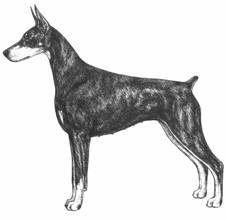
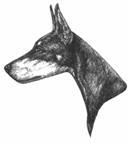
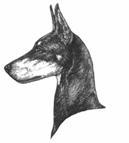
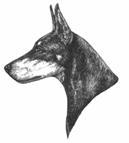
The neck should enable the dog to hold his head high, thus crowning a posture of nobility, pride, alertness, power and confidence. “Well muscled and dry” means the neck should be strong and firm without being thick or bullish and has no loose skin.
The standard asks for “Length of neck proportioned to body and head.” As a guideline in determining correct proportion, the head and neck should be about equal in length. The length of the head should be about half the length of the topline as measured from the withers to the onset of tail. This proportion can be verified by comparing the length of head, neck, and topline of the ideal Doberman Pinscher in the pictures in this Illustrated Standard.
Good length and a well-defined crest contribute greatly to the appearance of proud neck carriage. The natural arch along the nape of the neck should flow gracefully from the rear of the backskull downward, tapering smoothly into the withers. The front of the neck should flow from the throat downward in a smooth, gradually widening line to the forechest. The standard asks for the neck to be proudly carried and also to be well muscled and dry. “Dry” means the neck and throat should have no loose skin.. A ewe or concave neck is evidence of weak ligaments and should be penalized.
Stovepipe neck is an elongated tubular –shaped neck, lacking strength and crest
Ewe neck is a concave neck lacking an arch like that of a sheep
Short/thick (bullneck) is a powerfully muscled neck with an exaggerated thickness and course neck/shoulder junction.
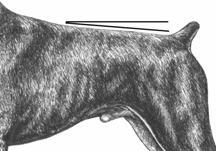
The topline includes the withers, back, loin and croup, with the withers marking the highest point of the topline. Efficiency of gait demands an almost level, straight back and a well-muscled loin. There should be no roach, hump or sag. Since efficiency of gait is imperative for the working Doberman, the exaggerated “ski-slope” topline sometimes seen is a deviation from the standard, as it significantly reduces efficiency. A short, strong back and muscular loin are necessary for the proper transfer of power from the hindquarters to the forequarters and for the flexibility and agility that enables the Doberman to do his work.
Typical topline deviations
Ideal
Excessive slope
Flat topline and croup
High in rear
Roach backed
Sway backed
Correct Doberman tail carriage is only slightly above the horizontal. When the dog is alert the tail carriage is between 3 o’clock and 2 o’clock . A tail carriage any higher indicates a flat croup, which is a deviation from the 30 degree hipbone angulation required by the standard.
The underline is formed by the brisket reaching to the elbow, flowing back parallel to the ground to the base of the ninth rib where the ascent of the ribcage begins. At that point, the underline gradually rises into a marked tuck-up that flows into a short loin. If the brisket line sweeps up at the fifth or sixth rib, the dog is herring gutted, which is a deviation from the standard, since a herring gut can diminish a dog’s stamina. The depth of the brisket, length and shape of the ribcage, and shortness of the loin and tuck-up all contribute to a correct underline and the desired appearance of power and endurance.
Typical underline deviations
Ideal
Too much tuck-up
Too little tuck-up
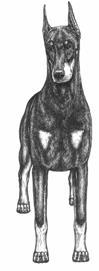
Ideal
The ribs are well sprung from the spine, although the first four or five ribs will not have as much spring or curve. This allows the shoulder blade to have greater freedom of motion. It also allows for proper elbow clearance as well as maximum heart and lung capacity, which enable the Doberman to work without becoming exhausted.
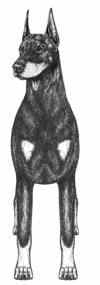
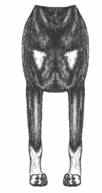
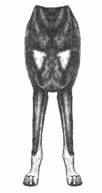
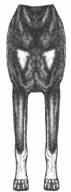
Viewed from the front, the chest must be broad; and the elbows are tucked in close to the brisket. The space between the forelegs is filled. The bottom of the brisket line between the elbows appears rounded. Viewed from the side, the forechest is well defined but not exaggerated. The depth of chest reaches to the elbows.
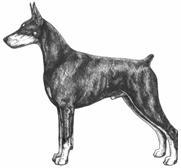
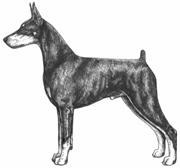
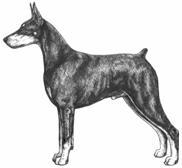
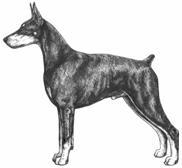
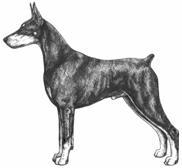
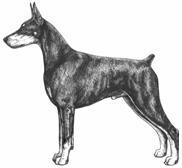
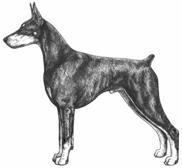
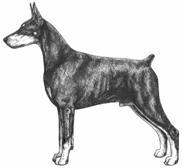
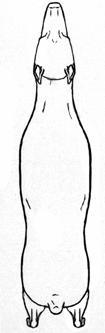
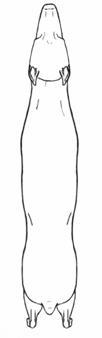
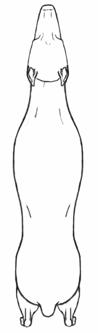
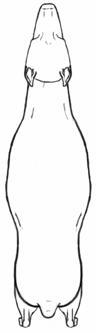
When looking straight down on the dog, the breadth of body across the shoulders, the widest point of the ribcage, and the breadth of muscles over the hips should all be approximately the same width. The loin should be wide, muscular and strong. It should curve inward slightly from the width of the ribs and flow back to full width again in the hindquarters. The overall picture from the top is one of a solid dog.
Correct width
Slab sided
Wasp waist
Barrel chest
Forequarters
AKC Standard
FOREQUARTERS
Shoulder Blade sloping forward and downward at a 45 degree angle to the ground meets the upper arm at an angle of 90 degrees. Length of shoulder blade and upper arm are equal. Height from elbow to withers approximately equals height from ground to elbow. Legs seen from front and side, perfectly straight and parallel to each other from elbow to pastern: muscled and sinewy, with heavy bone. In normal pose and when gaiting, the elbows lie close to the brisket. Pasterns firm and almost perpendicular to the ground. Dewclaws may be removed. Feet well arched, compact, and catlike, turning neither in nor out.
Commentary
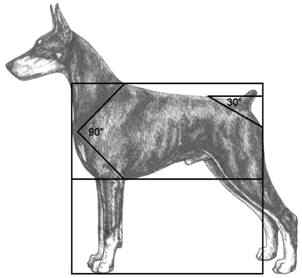
The shoulder blades of the Doberman are well laid back. The standard calls for a 45-degree layback of the shoulder and a 90-degree angle where the shoulder meets the upper arm. While this can be difficult to achieve, it is the ideal to strive for in a Doberman breeding program because it provides for maximum reach in the front assembly when the dog is gaiting.
The length of the shoulder blade should equal that of the upper arm. Deviations from the standard include upper arms that are too long, too short and/or too straight, as well as a front assembly that is set too far forward on the body. These deviations diminish the dog’s ability to efficiently perform the work for which he was bred.
The dog should be equal in measurement from the withers to the elbow and from the elbow to the ground.
The brisket is the deepest part of the body. It meets the elbow and appears slightly rounded between the elbows when viewed from the front.
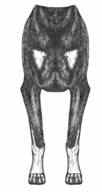
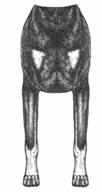
The leg bones are heavy. Muscles are well developed but sinewy and smooth. The shoulder blades should fit smoothly along the ribcage.
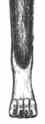
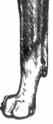
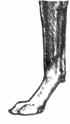
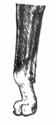
The pasterns should be short and firm. Note that the standard calls for the pastern to be “almost” perpendicular to the ground. A pastern that appears upright but has a very slight angle absorbs the impact of each foot fall when the dog is in motion. A pastern that is too upright is unable to flex and cannot absorb the shock of the dog’s weight landing on the front.
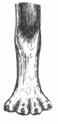
The feet are well arched, compact and catlike, and the toes are short, well arched and tight. A Doberman should not turn his feet in or out when standing or moving.
Typical Front Deviations
Ideal
Toes in
Elbows in
Narrow
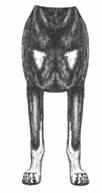
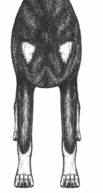
Elbows out
Wide
Typical Front Deviations
Ideal Front
Straight Front/Forward
Upper Arm
Pigeon Chest
Overdone ChestTypical Feet and Pastern Deviations
Correct foot
Splayed foot
Correct pastern
Weak pastern
Knuckled 0ver pastern
Hindquarters
AKC Standard
HINDQUARTERS
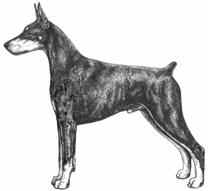
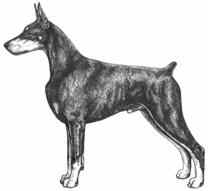
The angulation of the hindquarters balances that of the forequarters. Hip Bone falls away from the spinal column at an angle of about 30 degrees, producing a slightly rounded, well filled-out croup. Upper shanks at the right angles to the hip bones are long, wide, and well muscled on both sides of thigh, with clearly defined stifles. Upper and lower shanks are of equal lengths. While the dog is at rest, hock to heel is perpendicular to the ground. View from the rear, the legs are straight, parallel to each other, and wide enough apart to fit in with a properly built body. Dewclaws, if any, are generally removed. Cat feet as on front legs, turning neither in nor out.
Commentary
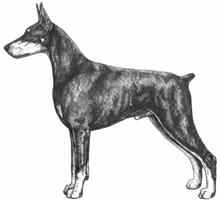
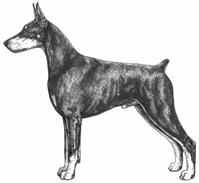
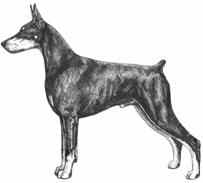
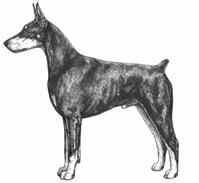
The correct tail carriage is only slightly above the horizontal. When the dog is alert, the tail carriage is between 3 o’clock and 2 o’clock .
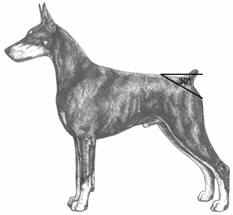
The ideal hip bone falls away from the spine at an angle of 30 degrees. An angle less than 30-degrees can create a flatter croup and a “gay” tail. An angle greater than 30-degrees results in a more pronounced rounding of the croup and a lower tailset than is called for in the standard. An improperly angled hip bone will affect the silhouette of the dog, which diminishes his conformity to breed type.
The angle of the Doberman’s croup is very important as it influences the dog’s gait. A flat croup does not allow a correct driving motion with feet close to the ground. A steep croup results in insufficient drive and follow-through of the hindquarters when trotting.
Tailset too high
Tailset too low
The standard calls for the hindquarters to be in balance with the forequarters. This statement can be taken to mean that the forequarters and hindquarters must be similarly angulated. However, given the standard’s overall emphasis on the ideal Doberman, the statement’s intent more accurately means that the hindquarters and forequarters should both be correctly angulated. The two must be judged in relation to each other but always with the ideal in mind.
The upper shank (1st thigh) and lower shank (2nd thigh) should be of equal length. The upper shank is the bone between the pelvis and the knee; the lower shank is the bones between the knee and the hock. The lengths of the upper and lower shanks should also be equal to the lengths of the shoulder blade and upper arm. A common deviation is a long lower shank.
Muscling on the upper and lower thighs is very important. You should be able to feel the well-defined muscling on both the inside and outside of the leg when running your hands over the hindquarters. Inadequate or unbalanced muscling on the upper and lower thighs creates some measure of instability in the hindquarters and therefore is a significant deviation from the standard.
Correct Rear
Long 2nd thigh
Straight rear
Long 2nd thigh, sickle hock, low tailset
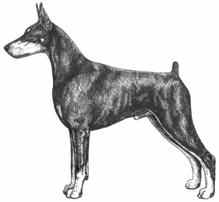
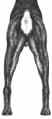
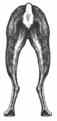
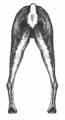
The stifle (or knee joint) is clearly defined, which means the stifle should not be overangulated or straight. More or less angulation is a deviation from the standard. When viewed from the rear, the rear legs should appear strong, well-muscled, parallel to each other and wide enough to balance the width of the body.
The length of the rear pastern, while not addressed in the standard, should be relatively short and perpendicular to the ground. The rear feet are the same as the front feet — well-arched cat feet that do not turn in or out when the dog is standing or moving.
Ideal
Cow Hocks
Spread Hocks
Coat
AKC Standard
COAT
Smooth-haired, short, hard, thick and close lying. Invisible gray undercoat on neck permissible.
COLOR AND MARKINGS
Allowed Colors: Black, red, blue, and fawn (Isabella). Markings: Rust, sharply defined, appearing above each eye and on muzzle, throat and forechest, on all legs and feet, and below tail. White patch on chest, not exceeding 1/2 square inch, permissible. Disqualifying Fault: Dogs not of an allowed color.
Commentary
The desired coat type is a short, hard, smooth, thick coat that seems to cling to the skin. Running your fingers backward through the coat, you will feel the hard texture; the length and tightness are evident. A good coat will return almost immediately to position with scarcely a hair out of place. The skin does not show through on a good coat. The blues and fawns (Isabellas) do not have the sheen of the blacks and reds, because of coat texture. The Doberman is a solid-colored dog with the specific “tan-point” pattern of rust markings.
While there is a considerable range of shades in each coat color, if the coat is not one of the four allowed solid colors, the dog must be disqualified.
Black is a defined black color. Blue (a dilution of black) is a bluish gray color. It is actually a medium-to-dark shade of gray and ideally has a definitely bluish cast. Red is really reddish brown, and the most desirable shade is the rich brown with a reddish glow.
Fawn (also referred to as Isabella, a dilution of red) is a silvery beige color. It should not be confused with the color of the fawn Boxer or Great Dane, as that is a lighter shade of fawn — more of a sandy color.
The desired color of markings is a deep rust-red but it may be somewhat lighter or darker. Sharply defined markings are preferable, as they enhance the characteristic look of the Doberman. The markings on the chest should be two small triangles, as opposed to a large unbroken banner.
Deviations to the standard include: Thin sparse coat, large splashy markings, light-colored markings, lack of markings, indistinct markings (melanism), markings that bleed into the solid color, absence of deep rich coat color, white chest patches larger than 1/2-inch square or white elsewhere on the dog.
Gait
AKC Standard
GAIT
Free, balanced, and vigorous, with good reach in the forequarters and good driving power in the hindquarters. When trotting, there is strong rear-action drive. Each rear leg moves in line with the foreleg on the same side. Rear and front legs are thrown neither in nor out. Back remains strong and firm. When moving at a fast trot, a properly built dog will single-track.
Commentary
The most efficient gait is one in which the dog moves in a straight line while using the fewest steps and keeping the feet close to the ground. Using the fewest steps for a given distance requires the longest natural stride. Anything other than as described above such as up-and-down motion, rolling or crabbing should be faulted to the extent of the deviation.
There are four requirements for the side gait to be correct:
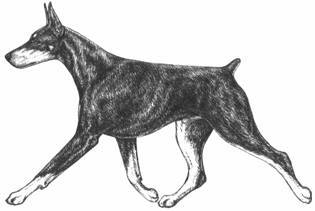
Correct topline — The head carriage is slightly forward, the neck blends smoothly into the shoulders, the topline from withers to croup is almost level, and the tailset is carried slightly above the horizontal.
Correct reach and extension — The front feet should hit the ground in line with the nose. The rear leg should extend to a distance that is equal to the distance of the front reach. Rear extension should include the rear pastern, which extends by a properly opening hock joint.
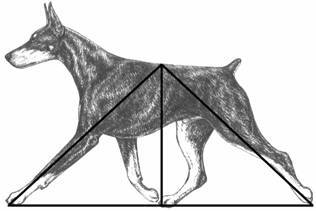
Correct foot placement under the body — The rear foot should step into the approximate area vacated by the front foot. Over-reaching or short-stepping in the rear should be penalized to the extent of the deviation.
Feet close to the ground — The feet should lift only slightly above the ground when moving, rising no farther than required for the feet to move smoothly. This manner of travel uses the least amount of energy and results in the most efficient movement.. Any wasted motion in the front or rear action should be considered a deviation from the desired Doberman gait
Three important elements are required for correct movement when viewed from the front or rear:
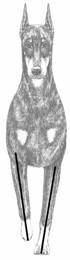
Columnar support — The dog’s joints are intended to absorb the impact of force in a straight-line manner. When impact travels straight through the joint, it remains stable and it works efficiently. If impact does not travel through the joint in a straight line, a lateral force occurs, which causes the joint to bend in a direction that it is not designed to bend. This is both inefficient and potentially damaging.
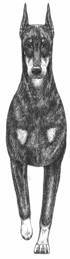
Convergence — The standard states that a well-built dog will single-track at a fast trot. Convergence is an element of balance and energy conservation. Since the legs are on the corners of the dog’s body, failure to converge will result in a rolling gait. This occurs because only one leg of a pair (front or rear) is on the ground at the same time. When only the left leg is supporting the dog, there will be a tendency for the dog to roll to the right. When only the right leg is supporting the dog, there will be a tendency to roll to the left. This rolling gait is well illustrated on wide-set breeds. A rolling gait is inefficient for a working dog,
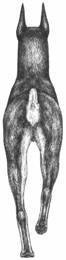
Foot placement — To verify that a dog is moving in a straight line, observe where the feet fall when the dog is coming and going. If the front feet are nearly blocked from view by the rear feet when moving away, or the rear feet are obstructed when coming toward, then the dog is truly moving in a straight line. Moving from side to side, side winding (crabbing), rolling, or bouncing take away from the desired straight line necessary for efficient gait.
Temperament
AKC Standard
TEMPERAMENT
Energetic, watchful, determined, alert, fearless, loyal and obedient. The judge shall dismiss from the ring any shy or vicious Doberman.
Shyness: A dog shall be judged fundamentally shy if, refusing to stand for examination, it shrinks away from the judge; if it fears an approach from the rear; if it shies at sudden and unusual noises to a marked degree.
Viciousness: A dog that attacks or attempts to attack either the judge or its handler, is definitely vicious. An aggressive or belligerent attitude towards other dogs shall not be deemed viciousness.
Commentary
There should be no compromise about temperament; it must be excellent. Temperament is a combination of a positive attitude, courage, intelligence, loyalty and alertness. When given a task, a Doberman should have the confidence and drive to ignore all distractions. If his attention is required briefly elsewhere, he responds and then returns to the task at hand. Dobermans are watchful. As the judge approaches, he may flick an ear or turn his head, but he is simply being aware of his surroundings. Loyalty and obedience should be reflected in the dog’s response to his handler.
Since temperament is fundamental to the Doberman’s reason for being, we must always be alert to undesirable temperament traits, and poor behavior must never be rewarded.
Energetic, watchful, determined, alert, fearless, loyal and obedient — these traits must be present for the Doberman to succeed at whatever task is asked of him and to do the work for which the Doberman was bred, unencumbered by reluctance or uncertainty.
The Doberman should be:
Energetic (Taut with a controlled power) The Doberman is always ready for action.
Watchful (Keenly vigilant) Wariness and cautiousness are deviations from the standard.
Determined (Single-minded) He should exhibit an uncommon focus in his execution of a task, undeterred by distractions or complex obstacles.
Alert (Aware of sounds, sights, smells, and every other detail of his surroundings) He should be quick and on guard, with an expression and posture that exemplify intensity.
Fearless (Resolute and responsive) The Doberman stands squarely at the ready, notably sure of himself and his purpose. He does not back away or appear nervous.
Loyal (Steadfast and devoted) Loyalty is the Doberman’s hallmark trait and therefore should be apparent in his attitude, expression and behavior.
Obedient The Doberman should be trainable and should respond immediately to any command. A Doberman must be clear-headed enough to disengage from an activity when commanded to stop. Unruliness and unresponsiveness are not acceptable behaviors.
Shyness must not be rewarded regardless of the dog’s age. Always remember that the Doberman is meant to be a fearless, self-assured breed.
Viciousness, like shyness, is a significant deviation from the standard. The standard distinguishes between aggression toward people and aggression or belligerence toward other dogs, which is not included in the definition of viciousness. Both shyness and viciousness should be dismissed from the ring, in accordance with the standard.
Assessing temperament begins by reading the dog’s eyes and body language. The desired look is one of interest, confidence and curiosity — even a twinkle of fun. Correct temperament says: “I can and will handle anything that is asked of me.” It is undesirable behavior for the Doberman to roll his eyes, cringe, clamp his tail or show any fear or unsteadiness. The Doberman should instead be steady, confident, fearless and wholly aware of you. Stability and strength of character are important to the breed.
AKC Standard
FAULTS
The foregoing description is that of the ideal Doberman Pinscher. Any deviation from the above-described dog must be penalized to the extent of the deviation.
Commentary
The best way to serve the Doberman is to strive for the ideal as specified in the standard in breeding programs, show rings, and performance events. To do otherwise would be a disservice to the Doberman, his past and his posterity.
“Breed type emerges from the whole standard.”