
submitted by Marj Brooks
I´ve been doing what I call “The Battaglia thing” on my litters for some time now and at present I have a Dachshund litter. When I first saw the article, I wanted to try it and see. I don´t have litters often but I do notice a positive difference. In the past I automatically handled the puppies in such a manner. When I read the article I was thrilled to learn I was doing “good” because I was criticized for handling my puppies like that – turning them upside down etc. I do think it´s important to follow the instructions in the article to the letter!!
A more detailed description of the exercises below may be found in Dr. Battaglia’s article “DEVELOPING HIGH ACHIEVERS”.
|
1. Tactile stimulation |
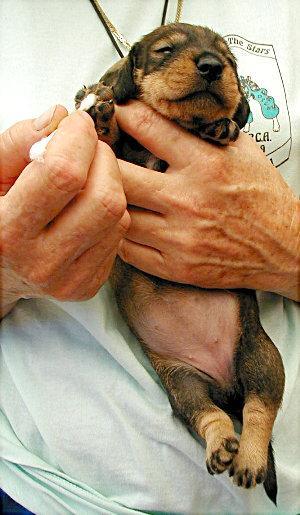 Figure 1 |
|
2. Head held erect |
|
3. Head pointed down |
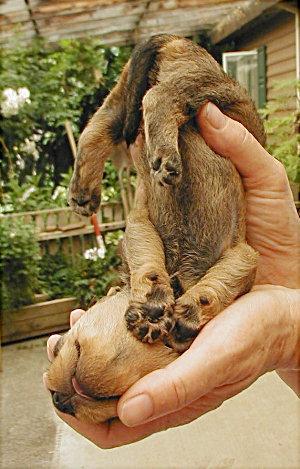 Figure 3 |
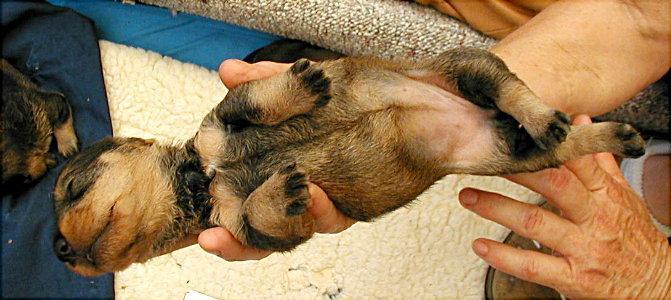 Figure 4 |
4. Supine position |
|
5. Thermal stimulation |
|
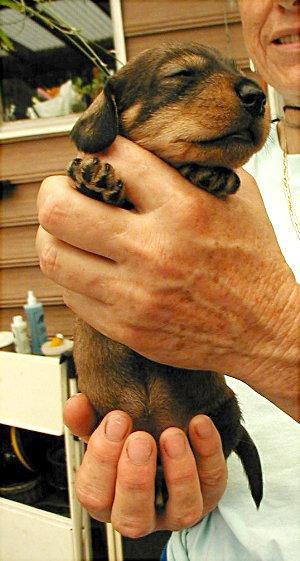

photos of puppies courtesy of Marj Brooks
I thought after reading the article, doing what I was already doing in a regimental manner made a lot of sense to me. It´s hard for me to put a finger on the differences in the pups but there is a difference.
With this Dachshund litter, the owners of the sire have been visiting regularly. On one visit (pups 20 days) I was showing and talking about the Battaglia program and suggesting they do it with their upcoming litter. They said they would do it because my puppies were the most advanced at this age that they had ever seen to date.
Darlene has been doing this on her litters for some time now too. Of course, I´ve shared this with anybody who will listen and have rave reviews from those who´ve done it. I will try to have them share their experiences and thoughts.
- published in the Winter 1997 Dachshund Review
- written & submitted by Marj Brooks, USA
Testimonials
from Susan Mone, Hollyoak Ranch
I have used the Early Stimulation technique for quite some time now on my Springers. I don´t remember where I first heard about it and exactly when I started using it but it has been several years now. Perhaps it might be better for me to share what I found when I did NOT use the Early Stimulation.
Right after one of my litters was born we had a death in the family. As you can imagine when something like that happens, your life no longer keeps to a regular schedule. We were going out of town frequently to deal with everything and my litter, while being lovingly cared for by other family members, did not receive the type of attention it normally would had I been there and the stimulation exercises did not get done. Other socialization techniques that I do with each litter similar to what is known as “the rules of 7” did not get done either.
What I discovered, as they grew and became adults, was that they did not seem to be as emotionally resilient as the previous litters. They had a longer recovery time from things that startled or frightened them. Interestingly, they also seemed to have a lower tolerance to pain, were generally not as bold and curious towards new things compared to previous litters that had the early stimulation and were not as easy to train. Also, that litter took longer than any previous litter for their eyes to open.
Not being a scientist, I cannot say for certain if these issues were due to the lack of the stimulation/socialization or the breeding itself but since I have been working within this bloodline for many years and did not observe anything unusual previously, I felt that it was indeed due to the lack of stimulation and socialization at critical stages.
Since this is my first Doberman litter, I cannot yet tell you of my findings in this breed but I believe from what I have seen in my Sp
ringers, the stimulation is very, very important to their overall development.
*** *** ***
from Deidre Wilsey-Koski
Dr. Battaglia´s early stimulation theory for neonatal puppies followed by the Rules Of Seven proved to be very beneficial for me in raising my last litter of Dobermans. Their growth stages, both neurologically and physically, were far more advanced than past litters.
Although I saw some of the usual “red flags”, that can cause me concern, I feel, that with minimal effort, we overcame them much easier.
These puppies are now almost 5 months old and have a better attention span which helps them learn faster. They have excellent coordination and adapt to new situations with less stress which helps them to be outgoing and easily socialized.
I will continue to use it in the future as I have found it to be a very helpful tool in raising well rounded and eager to learn puppies.
*** *** ***
#1 from Alva Keesal to Patty Smith
He is so confident. I came to the BIG GATES and asked Robbie to put him down. Watched him for a few minutes then entered. He came over to check ME OUT!! I asked him to follow me and he did with no hesitation. I made them take him into the house so he could sleep. They said he sleeps every 20 minutes….I said he’s a puppy and that’s what they need to do.
Then he became really serious about sleep. His blanket you sent was right in front of the fireplace. He was out in no time.
Do not worry. I think he will be the dominant one but I also think Fritz will let him. I warned them of this possibility. It will take time to see. Not to worry now. They will not be physically together until the ears are done. They promised me.
God what a great temperament. So good to see…
*** *** ***
#2 from Alva Keesal to Patty Smith
This puppy is so outgoing, SO NOT afraid of anyone or anything. He was chasing leaves that were blowing around the yard. He was never concerned that he couldn’t turn his back on anyone or on Fritz.
Fritz was kept outside the gates. The little guy was fence barking at ‘the big dog’. I think Brutus will be the dominant dog. I will monitor that as I will be doing the ears for a while.
The last thing the new owners said to me after thanking me two zillion times was…..”This will be the best dog we ever had!” How is that for a great future. I know you will miss him but be sure he is in a great place.
*** *** ***
from Patti
All 9 of my puppies in the litter have fabulous temperaments and I attribute some of this to the Neurological Exercises we did with the puppies from Day 3 through day 16. Marj Brooks made us aware of and encouraged us to do this and I would highly recommend anyone anticipating a new litter to do them. Every evening at 6:00, we examined each puppy, weighed each one and did the exercises. It became such a routine, we actually missed doing them at the end — it really was a fun and loving experience, focusing on each individual puppy.
from Dee Ryan Shaw to Patti
Patti, I have to agree with you here…I picked up a copy of the exercise descriptions at the ’99 National ( I think…) and used it for the litter of ten I bred last fall. It has had a lovely effect on the “kids”. They seem to take everything in stride and for those who met my puppy boy at Colorado
Springs – well, he’s never met a stranger while I’ve got him in public! I think his name fits him … Buddy…
But the exercises seem to have made a strong impression on the pups. Adaptable and unflappable. For what little time it takes, I’d certainly suggest that anyone who has a litter, perform these routines for the puppies.